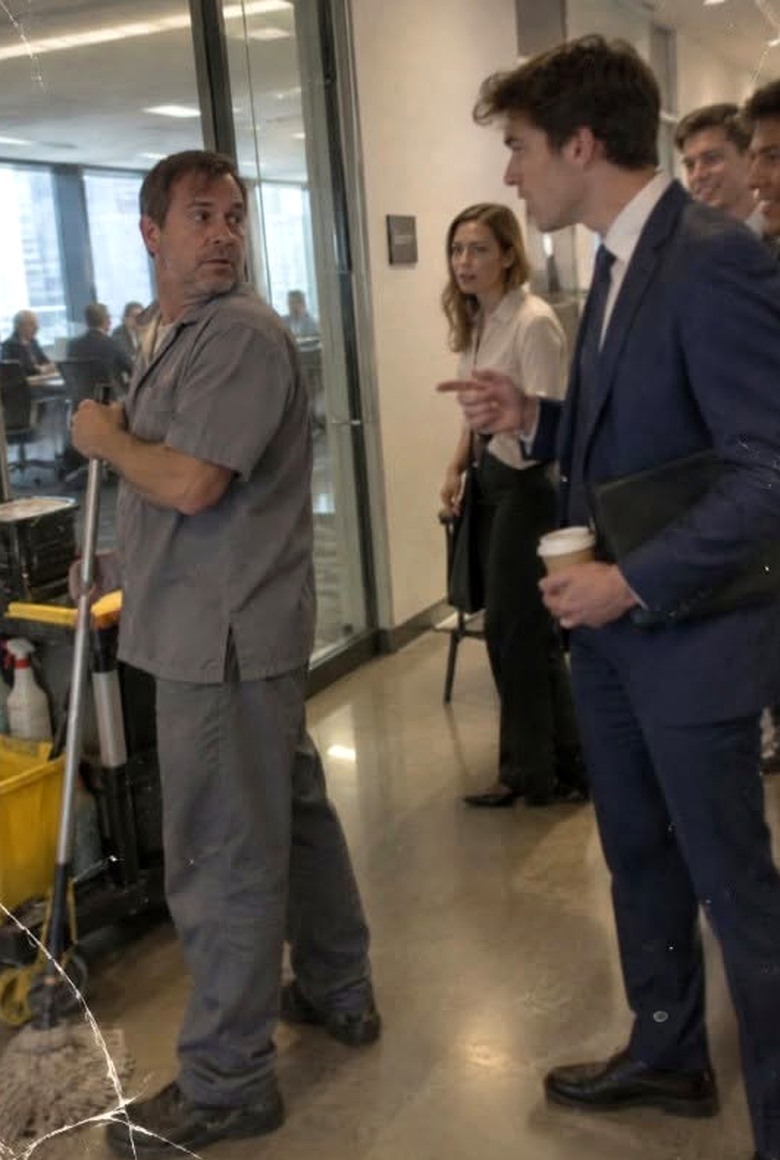
Maya, however, continued to be an anomaly. She’d offer a quiet “good morning,” or a small nod of acknowledgement. Once, she brought me a bottle of water, saying, “It’s hot in here.” It wasn’t the gesture itself, but the genuine concern in her eyes that struck me. She treated me like a person, not a function.
Marcus called daily, updating me on the company’s numbers. He also relayed snippets of gossip from the executive floor. Apparently, a major merger was on the table, a deal that could double Hartwell Freight’s revenue. The pressure was mounting on the trainees to perform. Tyler Reed was positioning himself as a star.
I overheard a conversation between Tyler and another trainee, Jessica Chen. “Did you see how Hartwell just *ignored* Miller this morning? Classic power move. Shows he’s not afraid to be seen with the little people.” Jessica laughed. “Exactly! You gotta play the game.”
The “game.” That’s what it had come to. A ruthless climb to the top, built on indifference and manipulation. I felt a cold anger building inside me. But I couldn't intervene. Not yet. I had to see how far this went. That evening, Marcus informed me that Tyler Reed had been flagged for ‘exceptional potential’ by the VP of Sales. The VP had even scheduled a private dinner with him.
Chapter 3: The Unseen Preparation
My grandfather, Arthur Hartwell, founded this company on a simple principle: treat people with respect. He’d started as a truck driver, working his way up through sheer grit and honesty. He believed a company was only as strong as its weakest link. Somewhere along the line, that philosophy had been lost. My father, focused on expansion and profit, had begun to prioritize results over values.
I’d inherited a financial empire, but also a crumbling culture. The employee surveys had painted a grim picture: rampant favoritism, a fear of speaking truth to power, and a pervasive sense of being undervalued. I’d tried to address it through workshops and memos, but nothing seemed to stick. That's when I remembered a story my grandfather used to tell me about a visiting inspector who disguised himself as a warehouse worker.
The preparation for this “experiment” had been meticulous. Marcus had secured a complete background check on “Ed Miller” – a recently retired facilities worker who’d agreed to let me use his name and uniform for a substantial fee. The camera in my shirt pocket was a necessity, Marcus insisted, to protect me from potential liability. But it felt like a compromise. I wanted to experience this authentically, without the safety net of surveillance.
I discovered that Tyler Reed's father was a major Hartwell Freight investor, a silent partner who wielded considerable influence. The dinner with the VP of Sales suddenly made a lot more sense. It wasn’t just about potential; it was about connections. Maya Bennett, on the other hand, came from a modest background. Her application highlighted her volunteer work at a local soup kitchen. She’d deferred her college admission to care for her ailing grandmother.
One afternoon, while cleaning the executive restrooms, I overheard the VP of Sales on a phone call. “...Reed is a natural. He understands the game. He's exactly the kind of aggressive leader we need to close this merger.” A chill ran down my spine. The merger. It wasn’t just about profits; it was about consolidating power. And Tyler Reed was the chosen weapon.
Later that day, Maya found me polishing a brass door handle. “Rough day?” she asked, her voice gentle. I hesitated, then nodded. “It can be.” She paused. “Sometimes, it’s the little things that get to you, isn’t it?”
The truth was finally coming out — and there was no turning back now… (Continue to Part 3 →)